|
If you were at the event and noticed something we've missed, or weren't there and have questions that we didn't get to address, write 2us@exploratorium.edu. We'd be glad to include your thoughts! -karen/mike
|
What
we noticed:
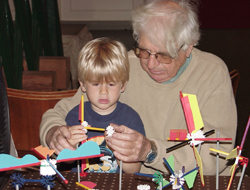
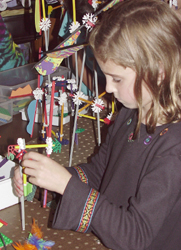
The visitors themselves determined the amount of time that they spend on the activity. There were no restrictions to the amount of time they spend, or number of visits they made. The tables were usually filled, and became a self-regulating system. Although the materials were not built to withstand excess thumping by thousands of museum visitors, they stood up very well. It is definitely possible to break apart the pieces and trash the activity, but it seems that the selection of more fragile materials, and the freedom to use them as visitors pleased, led to a more careful and purposeful interaction. All parts were loose, and often moved between construction areas, (including crickets and sensors) and no theft was noticed. Because most of the materials were familiar, but used in creative, unfamiliar ways, visitors seemed eager to start building, and interested in becoming as inventive as they could. The windmills and whirligigs are fun to look at, and somewhat simple to start building, then become increasingly more complex as the visitors ideas become complex. This range in complexity is an important part of keeping the visitors interest, and crucial to further their thinking. We hope to have a more interactive whirligig/cricket garden next time. We had too few examples of sensor activated contraptions. Because of this, most of the cricket and sensor exploration was limited to starting and stopping individual whirligigs, rather than creating more interactive IIR communication between whirligigs. Average time for participants was 10-20 minutes. About a quarter of the visitors stayed between 40 minutes to an hour. Comments about the activity and space: "cool," "I didn't think you could do that with K'Nex,'" "this is hard, oh I got it!" "Where can you buy these?" "Even though the museum is chaotic today, this space is calm, and inspiring." There was a good cross section of ages and an equal numbers of boys and girls...how about that? Something worth mentioning, everyone wanted to get their hands on crickets, so we - mainly Anita ;-) ended up plugging LEGO Mindstorms throughout the day. |