Head Harp
The String Section
Introduction
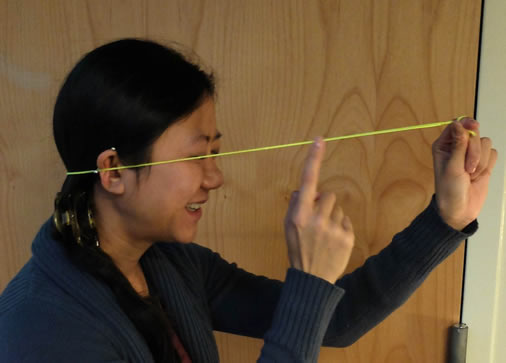
Wrap a string around your head and pluck it to play music. Hear how the frequency of vibration of a string depends on tension and length.
Material
A piece of string about an armspan long, 1.5 m.
To Do and Notice
Place the middle of the string behind your head, pull the string over your ears and hold the two free ends together in front of your face.
Pluck the strings.
Listen to the tone made by the string.
Pull the string tighter, or make it looser and listen to the change in pitch.
Change the length of the string while keeping the tension as constant as possible then listen to the change in pitch.
What's Going On?
When you pull the string tighter you increase the tension in the string and the pitch of the sound you hear increases.
When you keep the tension constant and decrease the length of the string the pitch increases.
You are hearing the resonant frequencies of a string.
The frequency is inversely proportional to the length of the string,
and proportional to the square root of the tension in the string.
You can hear your string, but the sounds produced by the string are so quiet you will not be disturbed by other people even if they are close to you.
Going Further
Two people can share this activity. Make a large loop of string and wrap it around two heads. Pluck the strings and play music for two.
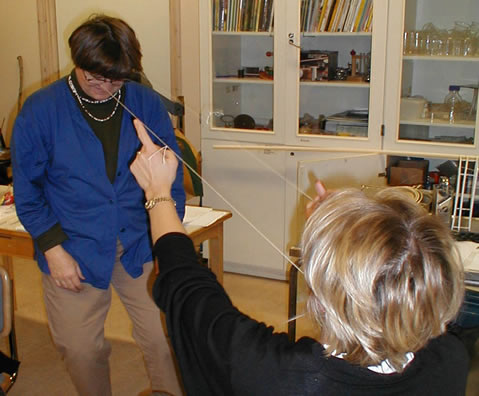
You can use a second person to hold the strings and pluck them while you close off your ear canals with your fingers. This seals off outside noises and allows you to hear the quiet sounds of the head harp string.
You can pull the strings off to one side keeping them under the same tension but making one string longer than the other. This will make the two different strings play two different notes.
Try strings of different mass and thickness, the frequency is inversely proportional to the square root of the mass per unit length of the string.
See also Rubber Band Pitch
Etc.
Many city bus services do not allow people to play loud music on the bus. We find that if you wrap a string around your head and play music not only will you not be in isolation of the city laws, but also other people on the bus will move away from you to give you more room.
Math Root
The fundamental frequency of oscillation of a string is the time it takes a wave pulse to move down the length, L, of a string, and then return to the start covering a total distance of 2L.
The time, t, to travel a distance, d, at constant velocity v is t = d/v.
This is also the period of one complete oscillation.
Since the distance traveled is d = 2L then t = 2L/v.
The frequency is the inverse of the period, f = 1/t.
The frequency of oscillation of the string is then f = v/2L
The velocity of a wave pulse is proportional to the square root of the tension, T.
The velocity of the wave pulse is inversely proportional to the square root of the mass per unit length of the string, m/L.
So v = (T/(m/L))0.5
|
Scientific Explorations with Paul Doherty |
|
21 October 2006 |