CSET Summer 2006 questions
Day 1
Stephanie recorded and posted on line Modesto's lecture on great places to eat and enjoy entertainment in San Francisco.
http://www.exo.net/~drsteph/modesto.html
Freecycle http://www.freecycle.org/
a source for physics teaching material.
Craigs List http://sfbay.craigslist.org/ also has free stuff.
Microwave oven http://en.wikipedia.org/wiki/Microwave_oven
Microwaves, are electromagnetic waves with wavelengths of 12 centimeters and frequencies of 2.45 GHz, since c = fL let's check,
L = c/f = 3 x 10^8 m/s /2.45 x 10^9 1/s = 1.2 x 10^-1 m = 12 cm.
Put a compact disk in the microwave under hi power for 3 seconds.
The microwaves push the electrons in the metal and create sparks whick vaporize the metal and burn the paint off the metal. Look at the resulting CD on an overhead projector.
A lightbulb in a microwave will absorb the 1000 W of power created by the microwave and glow brightly until it burns out.
Radiation
from powerlines. http://en.wikipedia.org/wiki/Electric_power_transmission
The National Reseach Council has reviewed all of the data on the health effects of electromagnetic radiation from powerlines and decided that there are no health effects.
Electromagnetic radiation at frequencies below visible light (Infrared, microwave, radio) cannot break chemical bonds and so is tremendously different in its effect on a human body than radiation at frequencies above visible light (UV, X-ray, gamma ray) in which each photon can break a chemical bond.
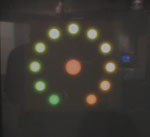
In this photo, my camera shows the cnter dot is the same color as the dot at 5 O'clock in the outer circle of dots. In the original exhibit my eye sees the dot at 1 O'clock as the same color.
We noticed how looking through rose colored glasses changed our perception.
Then Judy asked if the light we were adapted to before coming to the exhibit made a difference. We used the nearby red-green color adaptation exhibit to see what the answer to her question was by doing the experiment. Indeed the light we wre exposed to before coming to the exhibit changed which colors looked the same. We also looked at the exhibit from different distances and that also changed which colors looked the same.
"Do other people see the same colors I do?" No!
Under some conditions I don't even see the same colors I see (under other conditions).
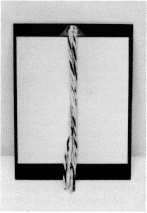
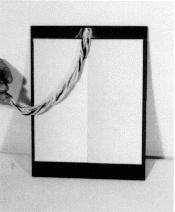
Both sides are the same?
Watch the basketball being bounced by the team in white shirts, count the number of times the ball bounces.
Day 2
The American Institute of Physics Guide to Metric Practice
http://www.physicstoday.org/guide/metric.html
The National Institute of Standards and Technology
Reference on Constants, Units and Uncertainty
http://physics.nist.gov/cuu/index.html
NIST Detailed Contents
http://physics.nist.gov/cuu/Reference/contents.html
The Wikipedia
Definition of the meter: http://en.wikipedia.org/wiki/Meter
Definition of the second http://en.wikipedia.org/wiki/Second
Speed http://en.wikipedia.org/wiki/Speed
Example Speeds http://en.wikipedia.org/wiki/Orders_of_magnitude_%28speed%29
acceleration http://en.wikipedia.org/wiki/Acceleration
The Physics Classroom Acceleration http://www.physicsclassroom.com/Class/1DKin/U1L1e.html
Here's a question from a High School physics teacher
I'm trying to write an explanation of the often cited example of
Newton's 3rd law: a person attempting to step off of an unsecured boat
onto a dock. The action is described as the person applying a force to
the boat, which causes a reaction: the movement of the boat away from
the person. Consequently the person maintains their position and falls
into the water.
I've reviewed many sources (which has confused me even more), but they
all seem to say the same thing: the force of the person on the boat
causes the reaction of the boat moving away. BUT, what's the reaction
FORCE???
I am looking for a (complete) explanation in terms of Newton's 3rd law
and action-reaction pairs. I realize it may be easier to explain this
example in terms of momentum, but I'd like to leave momentum out since I
want to concetrate on action-reaction pairs.
Any ideas?
Thanks in advance.
Borislaw
I'll follow up tomorrow with the answer he wrote after hearing replies from a dozen physics profesors . But before that how would you answer him?
Day 3
There is a good book titled "How to Lie with Figures"
Cheap stopwatches with no alarm and with replaceable battery are available from Mychron at $48 per dozen.
The Corning Museum of Glass has a reference that glass is a solid.
Sebastians wave movie link
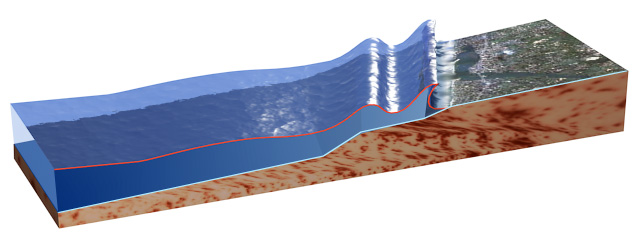
A tsunami wave comes to shore.
Animation of a water wave striking the shore.
|
Scientific Explorations with Paul Doherty |
|
10 October 2005 |