How bright is it?
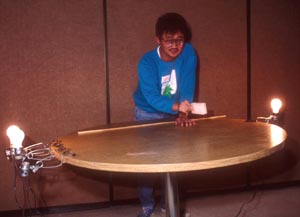
Tien Huynh-Dinh uses a photometer to find where where 1 60watt bulb
is as bright as 2 60 watt bulbs.
How bright is it?
Tien Huynh-Dinh uses a photometer to find where where 1 60watt bulb
is as bright as 2 60 watt bulbs.
Introduction
Say goodbye to those old incandescents! Fluorescent bulbs that fit traditional incandescent lamp sockets are now available. They use much less power to produce the same amount of light as incandescent bulbs. Here's an activity that lets you see this for yourself.
Material
A Photometer,
Two 1/4" Thick slabs of translucent, white, plastic at least 2.5 cm (1") square. (Available at Plastic stores) .
Aluminum foil.
Scissors.
A rubber band or transparent tape
Optional photometer
A Piece of typing paper about 10 cm on a side with a small drop of cooking oil smeared in its center.
Two lamps or wired sockets without shades or reflectors.
Three light bulbs: one "60 watt replacement" fluorescent bulb that fits a standard socket, and two identical 60-watt incandescent bulbs. Other brightnesses of bulbs will do. Just make sure they're not too bright to experiment with, and all three have the same power rating&emdash;the same number of watts (for the incandescents) and "watt replacement" (for the fluorescent). The fluorescent bulb will say the watt replacement number on the box.
The boxes that the light bulbs came in.
A pot holder or towel to help you handle hot light bulbs.
A meter stick.
Assembly
Cut the aluminum foil to the same size as the plastic slabs and put the foil between them. Use the two rubber bands or tape to hold the sandwich together.
You've just made a simple&emdash;but very effective&emdash;light comparator. By watching the edge of your plastic-and-aluminum foil light comparator, you can compare the brightness and color of two different kinds of light.
To make a comparator,
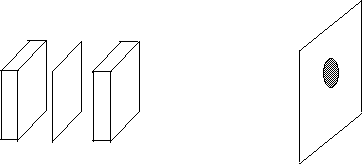
Aluminum foil is sandwiched between Or, a grease spot is made on a piece of two pieces of translucent plastic. paper.
Put the two identical incandescent bulbs in the lamps. Place the lamps about a meter or more apart, plug them in, and turn them on. Turn out the roomlights, and pull shades if you have them, however a little stray light is OK.
To Do and Notice
Hold your plastic-sandwich light comparator between the lamps so that the long, thin sides of the slabs are facing you, and so that the lamps shine on the large flat faces. Move the comparator back and forth between the bulbs and watch how it changes.
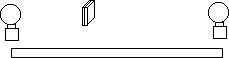
Hold the comparator between the two lamps, move it until the sides of the comparator appear equally bright.
Measure the distance from the center of each lamp to the center of the comparator.
Notice that the two sides of the comparator are equally bright when the comparator is held about halfway between the two lamps. Each bulb is giving off about the same amount of light. If the comparator must be moved closer to one lamp to achieve equal brightness then that lamp is putting out less light.
Now turn off the lights and carefully remove one of the incandescent bulbs. (You may want to wait a few minutes to let the bulb cool; then use a pot holder or towel to help you remove it.) Put the hot bulb carefully aside (bulbs roll!) and replace it with the fluorescent bulb. You should now have a fluorescent bulb in one lamp, and an incandescent bulb in the other.
Turn the lamps on and use the comparator once again to test the brightness of the bulbs. If the manufacturer's claims that the bulbs produce the same amount of light are correct, then both sides of the comparator will be equally bright when the comparator is halfway between the two lamps. With this activity, you can test the manufacturer's claim. If you have to move the comparator closer to one bulb to make the two sides of the comparator balance, then that's the bulb putting out less light.
Notice that the fluorescent bulbs gradually get brighter during the first few minutes of operation as they get warmer.
Hold a hand a few inches above each of the bulbs. Don't touch them! You should be able to easily feel that more heat is flowing from the incandescent bulb than from the fluorescent bulb.
Now take a look at the boxes the light bulbs came in. The electrical energy consumed by a bulb is listed on the box. Use the information to compare the amount of energy used by the two different kinds of bulbs to give off the same amount of light. The fluorescent bulb we experimented with claimed to use 15 watts of electricity to generate the same amount of light as a 60-watt incandescent bulb. The box also claimed that the bulb had a 10,000 hour lifetime compared to the normal 1000 hr. lifetime for incandescent bulbs.
What's Going On?
Even though both the incandescent bulb and the fluorescent bulb are almost equally bright, the fluorescent bulb uses only one-quarter of the energy&emdash;15 watts.
The fluorescent bulb is clearly more efficient than the incandescent bulb. The incandescent bulb emits more than 98% of its energy as invisible, infrared radiation, which warms its surroundings. The remaining few percent of the energy is emitted as visible light. The fluorescent bulb we tested, on the other hand, wasted only 12% of its energy. About 78% of the energy it used became visible light.
Sometimes wasted energy is useful; sometimes it's not. In Wisconsin in the winter, the heat emitted by a burning incandescent light bulb may be welcome. In Arizona in the summer, however, it might just add to an already-too-hot environment. If you have to turn on the air conditioner to correct the situation, the problem of wasted energy is compounded.
Math Root
Place the comparator between the two sources so that the brightnesses of the two sides are equal. Brightness is how a human eye perceives the intensity of light, where intensity is the power per unit area, measured in watts per meter2. At this position the intensities of the two lights are equal. The power, P, from each light source spreads uniformly over a sphere, so the intensity at a distance R from the center of each light is I = P/4pR2 .
I = P/4pR2
When the comparator finds the place where intensities from the two sources are equal,
I1 = I2. and
P1/4pR12)= P2/4pR22)
so that
P1/P2 = R12 , R22)
so if the comparator finds equal intensities 1.5 meter from one bulb and 1 m from the second then the more distant bulb is putting out 2.25 times the power in light as the nearer one.
P1/P2 = 1.52,12) = 2.25
Etc
If you've been experimenting with your light comparator, you may already have noticed a color difference between the light produced by the incandescent and the fluorescent bulbs. Incandescent bulbs tend to be orange, while fluorescent bulbs produce a range of colors, but are in general bluer. You can use your comparator to compare the colors of your bulbs to the color of the sun. Allow direct sunlight to shine on one side of your comparator. Light from the sun, which is made up of all the colors of the spectrum, is what we call "white" light.
Like most of the light bulbs we use, the sun is an incandescent form of light. That is, it emits light because it's hot. An incandescent bulb does the same thing. When an electric current passes through it, the tungsten filament heats up to about 2900 kelvins. That's about half the temperature of the sun. The glowing filament looks orange because it's cooler than the sun, and so gives off proportionately more long-wave radiation, which we see as reddish-orange light. If it could get hotter and hotter, it would look more and more white. You may have seen this same thing happen on an electric stove. When you first turn on a burner, it glows red. The hotter it gets, the whiter the burner looks.
When an electric current passes through a fluorescent bulb, the moving electrons excite the mercury vapor that fills the bulb. In response, the mercury vapor emits mostly high-frequency blue light (which we can see) and ultraviolet light (which we cannot see). A phosphorescent material that coats the inside of the bulb absorbs this ultraviolet light and emits lower-frequency, reddish, visible light. Different manufacturers use different phosphorescent materials which emit different frequencies of light, and so produce different colors. Some fluorescent bulbs glow pink, others look green, yellow, or blue. It depends on the phosphor that coats the bulb.
Wave a white-barreled pen rapidly back and forth over a piece of black paper in a room lit by fluorescent lights. Notice the bands of red and blue you can see as the stick or pen waves back and forth. The electric current passing through a fluorescent light reverses direction 120 times a second. When the current reverses the electrical arc dims. The phosphors however continue to emit their reddish light. When the current is flowing, you see the bright bluish light emitted by the mercury vapor. Then, when the current is off, you see the redder light emitted by the glowing phosphors. Together, the bluish and reddish light looks white.
|
Scientific Explorations with Paul Doherty |
|
27 June 2007 |